

Games & Visuals Tricity, October 16 at PJATK Gdańsk

Technology is advancing faster today than ever before. Artificial intelligence is changing the way developers work, cybersecurity is becoming one of the most important challenges of the modern world, and digital transformation is already affecting nearly every industry—from logistics and manufacturing to energy and public administration.
In such a dynamic environment, a university cannot simply update its list of courses. It must constantly ask itself: what kind of engineers will the world need in five, ten, or fifteen years?
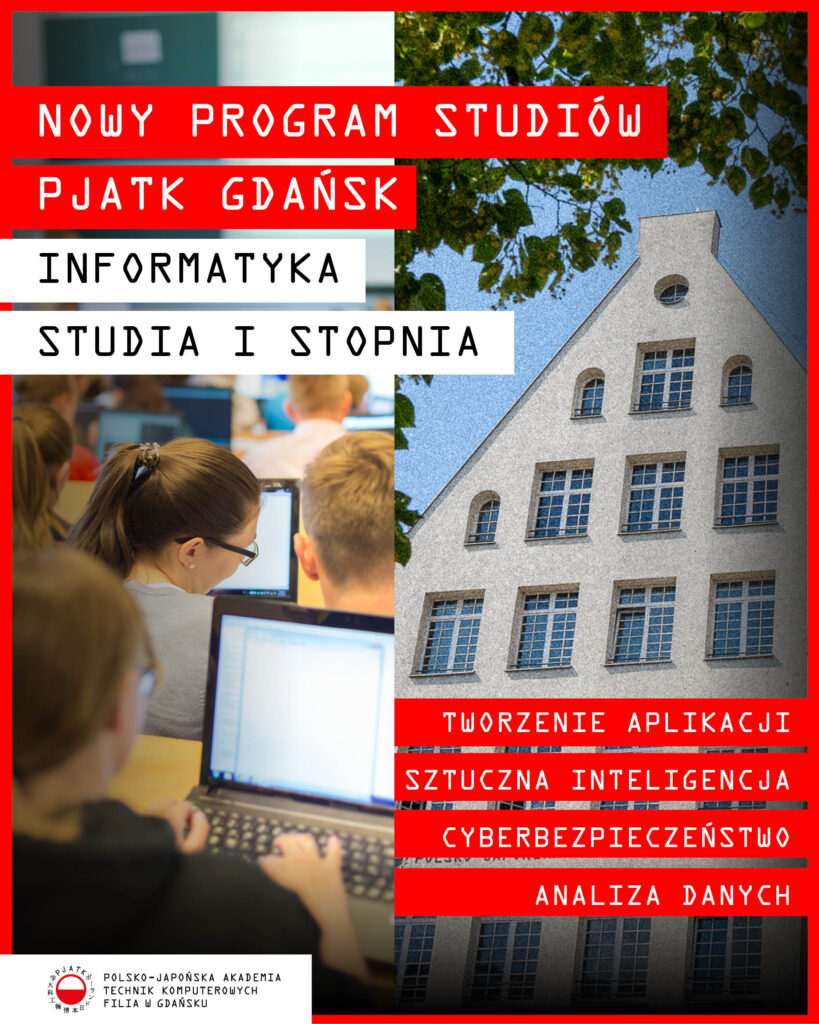
It was precisely this need that led to the creation of the new bachelor’s degree program in Computer Science at PJATK Gdańsk. It is not a response to a passing trend, but the result of a deliberate decision about how we want to educate future professionals.
When designing the new program, we looked not only at global technology trends but also at the region where we operate. For years, Gdańsk has been establishing itself as one of Poland’s most important hubs for new technologies. It is here that research and development centers are flourishing, along with companies developing software for clients from around the world, as well as businesses involved in logistics, automation, the maritime industry, and the energy sector. At the same time, Pomerania is becoming a natural hub for cooperation with countries in the Baltic Sea region—Scandinavia, the Baltic states, and Northern Europe. It is here that modern technologies, international business, and the maritime economy—which is undergoing an increasingly rapid digital transformation—converge.
That is why we want PJATK graduates to be prepared not only to work in the local job market, but also to carry out projects in the international environment of the entire Baltic Sea region.
Revamping a degree program isn't just about adding a few new technologies. It's a decision about what kind of engineers we want to train.
🚨 Should he know only the tools that are popular today?
🚨Should they be specialists who can still find their footing even when technology looks completely different a few years from now?
At PJATK Gdańsk, we chose the second approach. The new program was designed to develop both technical competencies and skills that remain relevant regardless of technological changes—critical thinking, problem analysis, accountability for designed solutions, collaboration, and the ability to learn continuously.
Dr. Radosław Stojek, dean of the Faculty of Computer Science at PJATK Gdańsk, has emphasized from the outset that the role of a university is not merely to respond to market needs. The mission of a modern university is to prepare students for a world that is still taking shape.
That is why the new program focuses on areas that will shape economic development in the coming years: artificial intelligence, data analysis, cybersecurity, and the design of modern information systems. However, skills that no technology can replace remain just as important—the ability to think critically, responsibility, collaboration, and a willingness to continuously develop. As Dr. Radosław Stojek emphasizes, the university should develop people who are capable of adapting, because this ability will be one of the most valuable skills of the future.
Today, digital transformation encompasses ports, maritime transport, logistics, offshore energy, industrial manufacturing, and the public sector.
All of these areas require specialists who understand both the technology and the complexity of business processes.
That is why the new Computer Science program has been designed to produce engineers capable of working in an interdisciplinary manner, communicating with experts in various fields, and creating solutions that address the real needs of the economy.
This approach is particularly important in Gdańsk—a city that has for centuries been a hub for the exchange of knowledge, people, and technology, and is now becoming one of the pillars of digital development in the Baltic Sea region.
The new program places a strong emphasis on project-based work. From the very first semesters, students develop their own solutions, work in teams, and build a portfolio that becomes a natural part of their professional development. Classes are taught by both faculty members and industry professionals collaborating with businesses, ensuring that theory is immediately applied to real-world project challenges.
Although the program incorporates the latest technologies, people remain its most important element.
✨ Technology will continue to evolve. New programming languages, new tools, and new artificial intelligence models will emerge.
✨ However, the need for people who can analyze, collaborate, make responsible decisions, and design solutions that have a real impact on the world around us will not change.
These are precisely the kinds of graduates we aim to educate at PJATK Gdańsk. Because we believe that a good university does more than just respond to market needs. It should also help shape the future of the region in which it operates.
“Gdańsk has always been a place where people, ideas, and technology come together. Today, it plays a similar role in the digital economy of the Baltic Sea region. We want PJATK graduates to be not only participants in these changes, but also their initiators—engineers who can create solutions for Poland, Scandinavia, and the entire Northern European region,” — concludes Dr. Radosław Stojek, dean of the Faculty of Computer Science in Gdańsk.
Computer Science – Bachelor’s degree (Engineering), full-time and part-time programs. Ideal for future programmers, cybersecurity specialists, game developers, and artificial intelligence specialists.
Graphic Design – Bachelor’s degree program (first-cycle), offered as both full-time and part-time options at the Faculty of New Media Arts. For those who want to design graphics, create animations, or work in multimedia art.
Graphic Design and Multimedia Art – Master’s Degree Program (full-time) at the Faculty of New Media Arts.
Take a step toward the future and join our community. Visitthe PJATKadmissions portal and submit your application today! We accept applications online through our e-admissions system.